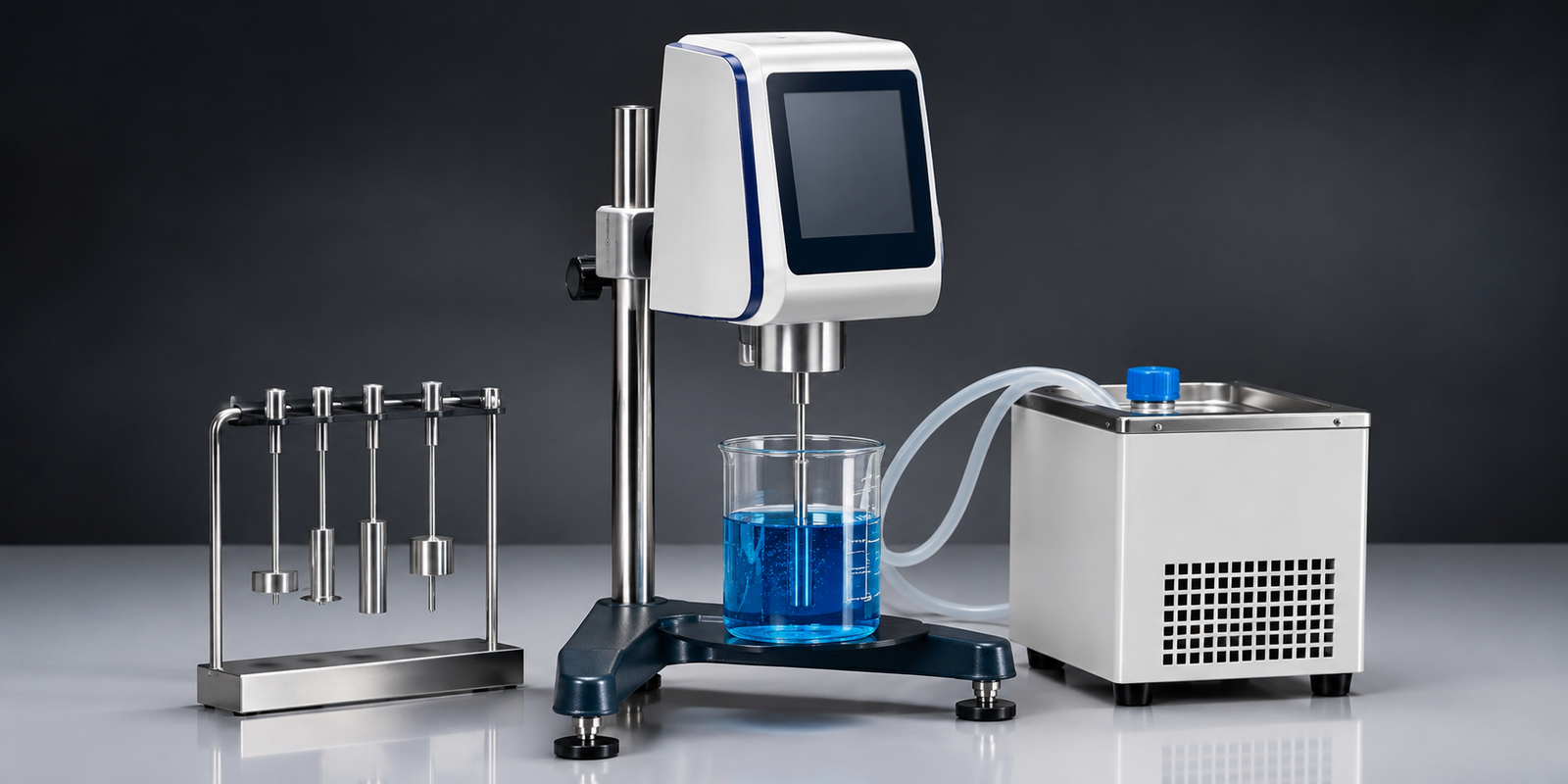
Quick answer: A viscometer measures how thick or runny a liquid is. For most laboratories, a rotational viscometer is the practical all-rounder, while glass capillary viscometers suit clear, thin liquids tested to methods like ASTM D445 or ISO 3104. Price depends on the viscosity range, accuracy, temperature control and accessories, so settle your samples and test method before you ask for a quote.
Pour honey, then pour water, and you already understand viscosity. In a lab the same idea has real consequences: a paint that sags, a cream that separates, an oil that thins out too much when it heats up. Each of these can be traced back to a viscosity reading, and that reading is only as reliable as the instrument, the temperature control and the way the sample was handled.
This guide walks through what viscometers are, how the main types differ, which specifications are worth your attention, and what to ask a supplier before you buy. It is written for lab managers, QC teams and buyers in India who would rather choose well once than replace an instrument later. Bionics Consortium has 26 years of experience, and the advice below reflects the practical questions that come up around laboratory equipment.
A viscometer is an instrument that measures a fluid's resistance to flow, known as its viscosity. Laboratories use it to check incoming raw materials, keep production batches consistent, compare formulations and confirm that a product meets its specification.
Two terms appear again and again, and mixing them up causes confusion:
Capillary instruments give kinematic viscosity directly, while rotational instruments give dynamic viscosity. Check which one your test standard or customer specification asks for; it often narrows the choice before you look at a single product.
A viscometer reports viscosity under a set of defined conditions. A rheometer goes further and studies how a material flows and deforms across a wide range of shear rates and stresses, which reveals things like yield stress and elasticity. For routine quality control against a target value, a viscometer is usually enough. If you are developing products with complicated flow behaviour, it is worth talking about a rheometer as well.
A spindle turns in the sample at a chosen speed, and the instrument measures the torque needed to keep it turning. The thicker the fluid, the more torque it takes. Because you can swap spindles and change speeds, one instrument covers a broad range of materials, which is why rotational models are the usual first choice for paints, adhesives, creams, resins, sauces and many chemical formulations. They also cope with non-Newtonian fluids, as long as you record the spindle and speed you used.
Here the sample flows under gravity through a calibrated glass capillary, and the flow time is converted into kinematic viscosity. Ostwald and Ubbelohde designs are the ones most people know. They are very precise for clear, Newtonian liquids such as solvents, fuels and oils, and they are tied to standard methods like ASTM D445 and ISO 3104. The trade-off is that they need a temperature-controlled bath, careful cleaning and a steady hand.
A ball drops through the sample in an inclined tube, and the fall time points to the viscosity. These are straightforward to use but limited to suitable, transparent liquids.
Ford and Zahn cups record how long a fixed volume takes to drain through an orifice. They are quick, cheap and popular on the shop floor for paints and coatings. Keep in mind they give a relative flow time, not a true viscosity.
These are mainly used to monitor viscosity continuously in a process. For most laboratory work, rotational and capillary instruments cover nearly everything.
|
Type |
What it reports |
Best suited for |
Main limitation |
|
Rotational |
Dynamic viscosity (mPa·s / cP) |
Paints, adhesives, creams, resins, food products, chemical formulations |
Result depends on spindle, speed and temperature |
|
Capillary (glass) |
Kinematic viscosity (cSt) |
Clear Newtonian liquids, fuels, oils, solvents |
Not suited to opaque or non-Newtonian samples; manual handling |
|
Falling ball |
Dynamic viscosity |
Transparent liquids |
Limited to suitable, clear samples |
|
Efflux cup |
Flow time (relative) |
Quick shop-floor checks on coatings |
Not a true viscosity value |
Take a rotational viscometer as the example. A careful test usually goes like this:
That last step is the one people skip. A viscosity number without its test conditions is close to meaningless, particularly for fluids whose viscosity changes with shear rate. Two labs can get different answers from the same sample simply because they used different spindles.
Look past the headline range on the brochure. These are typical published figures for benchtop rotational viscometers; confirm exact values for the model you are quoted.
|
Specification |
Typical figures |
Why it matters |
|
Viscosity range |
15 to 2,000,000 cP (low-range models) |
Must cover all your samples |
|
Speeds |
0.3 to 100 rpm, about 18 speeds |
Tests shear-dependent flow |
|
Spindle set |
4 to 7 spindles |
Suits thin to thick samples |
|
Accuracy |
±1% of full scale (digital) |
Reliable readings |
|
Repeatability |
About 0.2% of full scale |
Consistent repeat results |
|
Temperature |
About 0 to 40 °C operating |
Viscosity changes with heat |
|
Calibration |
Certificate plus standard fluids |
Traceable results |
Always read the datasheet of the exact model before you buy.
There is no single viscometer price, because two instruments with the same name can be configured very differently. The main cost drivers are:
When you request a quote, ask for a line-by-line list of what is included. Two prices only compare fairly if the accessories, calibration and warranty match. If you already know your sample type and viscosity range, you can send them through our contact form and ask for a quotation that matches.
When you buy a viscometer in India, the supplier's technical understanding matters as much as the product. A good conversation should cover:
Bionics Consortium has 26 years of experience supplying laboratory equipment. You can see the current range on our viscosity testing equipment page, and confirm exact specifications and configurations directly with the team so you get accurate, up-to-date information.
Not sure which viscometer fits your samples? Send your sample type, viscosity range and test method through the Bionics Consortium contact , and the team can help you shortlist a suitable configuration and share a quotation.
The best viscometer is the one that matches your samples, your test method and your temperature setup, not the one with the longest feature list. Start with those three, then compare range, accuracy, calibration and service support. Do it in that order and you end up with an instrument that gives repeatable results for years.
It measures how resistant a liquid is to flow. Laboratories use it for quality control, formulation work and research.
Dynamic viscosity measures internal resistance to flow (mPa·s or cP). Kinematic viscosity is dynamic viscosity divided by density (mm²/s or cSt).
A rotational viscometer is usually the most versatile, since changing the spindle and speed lets it handle a wide range of liquids and semi-liquids.
Price depends on type, range, accuracy, accessories, temperature control and calibration. Ask for a detailed quotation that matches your requirements.
A viscometer reports viscosity under set conditions. A rheometer describes flow and deformation across many shear rates and stresses.
Viscosity changes with temperature, so even small variations can alter the result. Controlled temperature keeps readings repeatable and comparable.
Follow the manufacturer's guidance and your quality system. Many labs also run periodic checks with certified viscosity standard fluids between formal calibrations.
Not always. Very thin liquids, very thick pastes and shear-sensitive materials may need different spindles, geometries or instrument types.
The viscosity value and unit, temperature, spindle or capillary used, speed for rotational tests, sample details and the test method followed.
Confirm the viscosity range, accessories, calibration certificate, warranty, service support and suitability for your test method.


Connect with us for your business enquiries. Generally, we respond within a day.