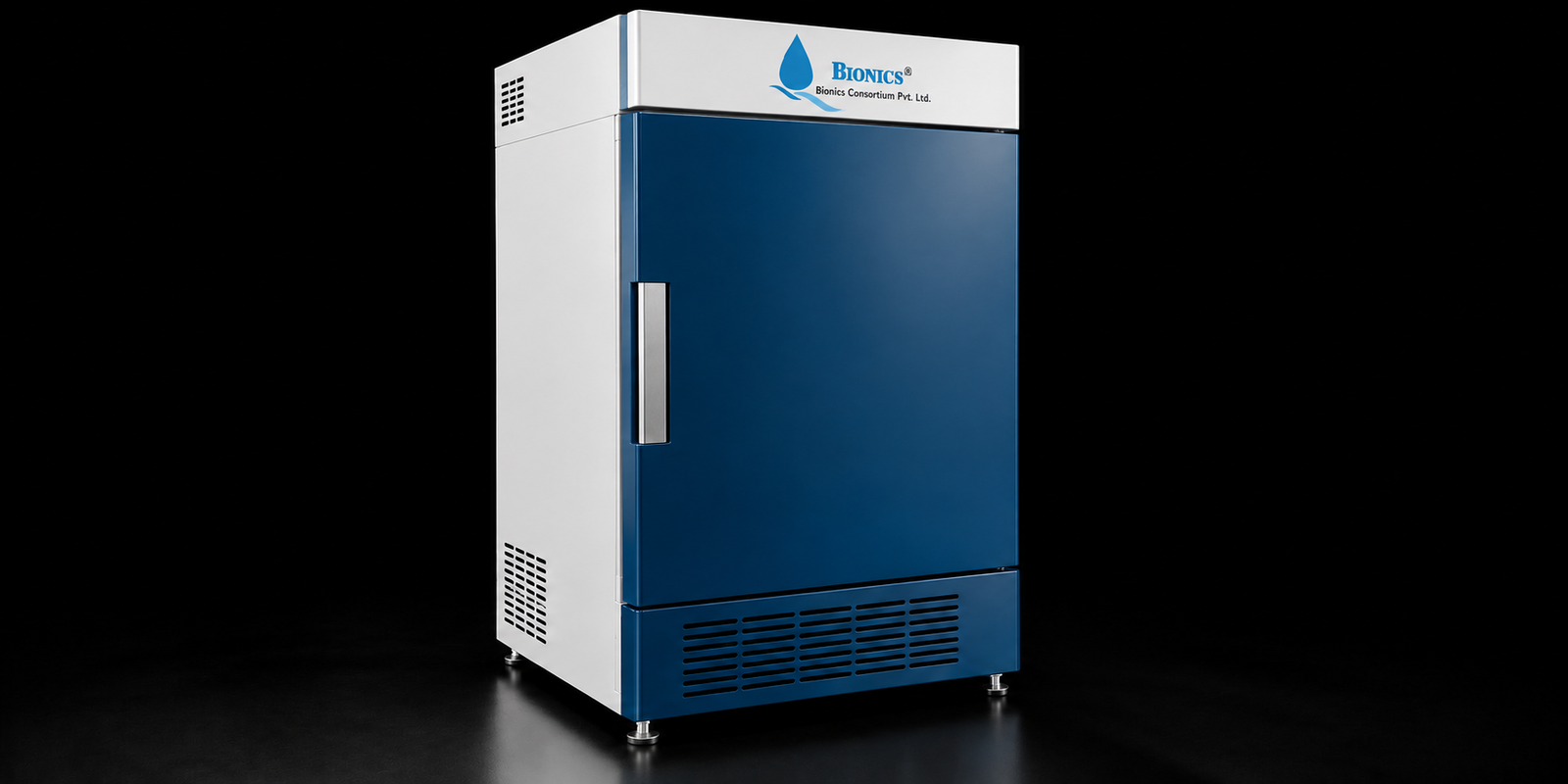
Quick answer: Laboratory incubators are insulated, thermostatically controlled chambers that hold cultures and samples at one stable temperature, usually between 5°C and 60°C. CO₂ and shaking versions add gas control or agitation. Bionics Consortium manufactures bacteriological, BOD, CO₂ and shaking incubators and has 26 years of experience in laboratory-equipment manufacturing.
A culture that drifts by two degrees can fail a sterility test or skew a BOD result. Incubators run around the clock, so how well a chamber holds temperature after a door opening or a hot afternoon matters more than the number on the display. We build our incubators ourselves and supply them directly to buyers in India and overseas.
They are enclosed chambers that keep biological or chemical samples at a controlled temperature, sometimes with controlled gas or agitation. Four formats cover most needs:
A Pt100 sensor reads chamber air temperature, and a PID controller adjusts power to the heating elements. Refrigerated units also switch a hermetic compressor to hold below-ambient set points. Forced-air models recover faster after door openings and give tighter uniformity than gravity-convection models. CO₂ chambers hold gas level with an infrared or thermal-conductivity sensor, and humidity comes from a water tray. An independent over-temperature cut-off is essential for overnight runs.
Typical values; confirm against the datasheet of the exact model.
|
Parameter |
Bacteriological |
BOD |
CO₂ |
Shaking |
|
Temperature range |
Ambient +5°C to 60°C |
5°C to 60°C |
Ambient +4°C to 50°C |
Ambient +5°C to 60°C |
|
Uniformity |
±1.0°C |
±1.0°C |
±0.5°C |
±1.0°C |
|
Volume |
50–1,000 L |
100–1,000 L |
50–250 L |
Bench to floor |
|
Gas / speed |
None |
None |
CO₂ 0–20% |
30–300 rpm |
|
Supply (India) |
230 V, 50 Hz |
230 V, 50 Hz |
230 V, 50 Hz |
230 V, 50 Hz |
Interiors are stainless steel 304 with microprocessor PID control. Uniformity figures describe a lightly loaded chamber.
Quotations for similar-sounding incubators can differ widely because the build differs.
|
Factor |
Effect on price |
|
Chamber volume |
Rises with size |
|
Refrigeration |
Higher than heat-only |
|
CO₂ and humidity system |
Highest of the standard formats |
|
Shaking drive |
Higher than static units |
|
Controller and data logging |
Rises with features |
|
Stainless steel grade and finish |
Rises with grade |
|
Calibration and qualification documents |
Adds cost when supplied |
|
Destination |
Voltage setting, packing and freight |
Compare offers against one written specification.
|
Criterion |
Bacteriological |
BOD |
CO₂ |
Shaking |
|
Below room temperature |
No |
Yes |
No |
Refrigerated versions only |
|
Best for |
Routine microbiology |
BOD tests, stability holds |
Cell culture |
Broth cultures |
|
Relative price |
Lower |
Medium |
Higher |
Medium to higher |
Pharma and biotech labs use incubators for microbial limit tests, sterility incubation and cell culture. Water and food labs use them for BOD and plate counts, and hospitals for culture work.
India: wide seasonal temperature swings and mains fluctuation make a voltage stabiliser worth specifying. Supply is 230 V, 50 Hz.
Saudi Arabia: high ambient temperatures favour refrigerated units. The grid runs at 60 Hz, so state frequency when ordering. Confirm import conformity (such as SABER) with your importer.
Oman: supply is 240 V, 50 Hz. Coastal humidity makes regular gasket inspection important.
USA: supply is typically 120 V or 208/240 V at 60 Hz. Buyers often ask for a recognised safety listing, so state it at enquiry.
Confirm voltage, frequency and plug type at the installation site.
We manufacture rather than resell, with 26 years in laboratory-equipment manufacturing. Quotations carry a written specification so offers compare line by line, and voltage, frequency and packing are set for the destination.
Send your temperature range, volume, application and delivery country, and we will reply with a specification and quotation.
Heat-only models run from about 5°C above room temperature to 60°C, BOD models from 5°C to 60°C, and CO? models from ambient +4°C to 50°C. Check the exact model's datasheet.
A bacteriological incubator only heats. A BOD incubator adds a compressor, so it holds sub-ambient set points such as 20°C.
For mammalian cell culture. It regulates CO?, usually 0 to 20%, and humidity to keep medium at the right pH.
Pick a chamber that leaves shelves about two-thirds full at peak load. If your workload may grow, go one size up.
Volume, refrigeration, CO? and humidity systems, controller options, finish and documents. Compare quotes on the same specification.
Only if the set point is well above room temperature. In hot regions choose a refrigerated model or an air-conditioned room.
Usually once a year, more often under GMP, GLP or accreditation rules, and after relocation or sensor replacement.
Part 11 is a US FDA rule on electronic records and signatures. An incubator cannot make a lab compliant alone, but audit trails and user access levels can support compliance.
Yes. We set voltage and frequency for the destination at the order stage. Send the delivery country with your enquiry.
Disinfect the interior, clean the water tray, check the door gasket and keep condenser coils dust-free. Calibrate the sensor yearly.


Connect with us for your business enquiries. Generally, we respond within a day.